The Future of Software Development with AI in 2026 & Beyond
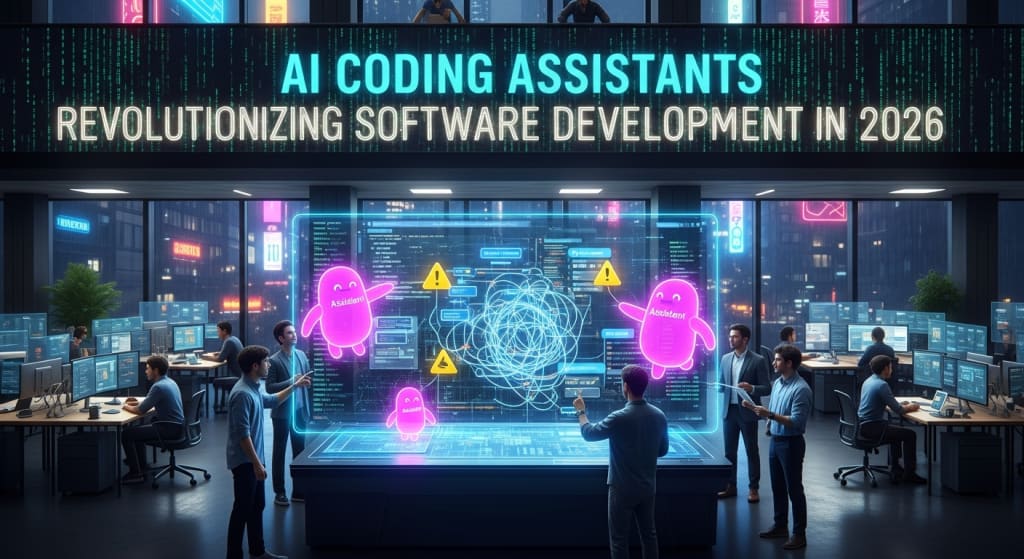
As we enter January 2026, artificial intelligence is no longer just assisting software development—it's fundamentally reshaping it. From AI agents autonomously handling complex tasks to repository intelligence understanding entire codebases, the industry is shifting toward AI-native workflows. Developers are becoming orchestrators of intelligent systems, focusing on high-level strategy while AI manages repetitive and intricate details. This in-depth guide (over 2,000 words) explores current trends, key predictions for 2026, benefits, real-world examples, challenges, and the evolving role of human developers in an AI-driven future.
1. The Current State: AI as a Core Development Tool
In early 2026, AI tools like GitHub Copilot, Cursor, Amazon Q, and advanced agents are mainstream. Developers accept 40-60% of AI-generated code suggestions, accelerating workflows significantly. AI handles boilerplate, debugging, testing, and refactoring, allowing teams to iterate faster.
Industry data shows commits and pull requests up 25% year-over-year, driven by AI productivity gains. However, human oversight remains crucial for quality, security, and innovation.
2. Key Trends Shaping 2026
Experts from Microsoft, AT&T, Forrester, and others predict transformative shifts:
- AI Agents as Teammates: Autonomous agents proliferate, handling multi-step tasks like feature implementation or bug resolution.
- Repository Intelligence: AI understands code history, relationships, and context across entire repos, enabling smarter suggestions.
- AI-Fueled Coding: New methodologies shorten cycles, enabling on-demand apps and agile evolution.
- Agentic AI Dominance: Systems plan, reason, and execute with minimal input, building AI-native applications.
- Multimodal & Edge AI: Models integrate vision, action, and edge deployment for specialized domains.
- Open-Source Advances: Diversification, interoperability, and governance harden AI frameworks.
These trends make software development faster, more accessible, and innovative.

3. Benefits for Developers and Organizations
AI integration delivers measurable gains:
- Productivity Surge: 50-70% faster coding and debugging.
- Shorter Cycles: From months to weeks for new features/apps.
- Improved Quality: Fewer bugs, better adherence to best practices.
- Democratization: Non-coders build prototypes; smaller teams compete.
- Focus on Innovation: Humans tackle architecture, ethics, and novel problems.
- Cost Efficiency: Reduced development time and maintenance.
Example: Enterprises using agentic platforms automate 50-60% of SDLC efforts.

4. Real-World Examples and Predictions
Leading implementations include:
- GitHub's massive PR/commit growth via AI.
- Agent platforms like ACE orchestrating full engineering personas.
- Multimodal agents in healthcare/UX for autonomous tasks.
- Predictions: Fully autonomous agents for routine changes; AI-native apps dominate.
By mid-2026, expect gigawatt-scale clusters accelerating AI development loops.
5. Challenges and Ethical Considerations
Risks include:
- Hallucinations & Errors: Incorrect code requiring review.
- Security Vulnerabilities: AI-suggested flaws or IP issues.
- Job Evolution: Shift to orchestration; potential junior role changes.
- Bias & Governance: Need for transparent, audited models.
- Over-Reliance: Erosion of fundamental skills.
Mitigations: Human-in-the-loop, robust testing, ethical frameworks.
6. The Evolving Role of Developers
Developers become "agentic engineers" or conductors—directing AI, verifying outputs, and innovating. Demand grows for AI orchestration, prompt engineering, and system design skills.
Conclusion
The future of software development with AI in 2026 is collaborative and transformative: AI handles scale and speed, humans provide creativity and oversight. Trends like agentic systems and repository intelligence will accelerate innovation, shorten cycles, and democratize building. While challenges exist, the hybrid model amplifies human potential. Embrace AI tools now—learn to orchestrate agents, integrate intelligence, and lead the AI-native era. The next wave of software breakthroughs awaits those who adapt.